

Selling your Canadian startup comes down to two decisions: recognizing when you’re ready to exit, and systematically identifying the right buyers. Most founders wait too long or reach out to the wrong acquirers, but the process becomes straightforward once you treat acquisition as a structured campaign rather than a waiting game. The optimal time to sell isn’t when you’re desperate for capital or burned out. It’s when your startup has proven a repeatable model, built defensible assets (whether that’s technology, customer relationships, or market position), and can demonstrate clear value to strategic or financial buyers. From there, the work shifts to preparation: assembling a data room, building a target buyer list, crafting personalized outreach, and managing due diligence without derailing operations.
Canadian startups face unique dynamics. Acquirers often come from south of the border, where valuations can be higher but expectations around revenue milestones are steeper. Domestic buyers, particularly in industries like fintech, health tech, and clean energy, increasingly compete for proven teams and technology that align with their growth mandates. Understanding who values what you’ve built, and why, is half the battle.
This guide walks you through the entire acquisition journey: the materials you need ready before conversations begin, the risks to guard against, a step-by-step process for finding and engaging buyers, and how to verify you’ve found the right match. Whether you’re exploring platforms like BizListings or running a targeted outreach campaign to strategic acquirers, the principles remain consistent. Treat your exit with the same rigor you applied to building the business, and you’ll maximize both valuation and deal certainty.
Recognizing When It’s Time to Sell
The decision to sell rarely announces itself with fanfare. For most Canadian founders, it emerges gradually through a mix of personal reflection, market observation, and honest assessment of what the business needs next. Recognizing these signals early gives you control over the process rather than being forced into a reactive sale.
One powerful trigger is realizing you’ve accomplished what you set out to do. Maybe you built the technology, proved the market exists, or established the customer base you envisioned. That initial mission completion often coincides with the startup needing skills you don’t have, scaling operations across provinces, navigating enterprise sales cycles, or managing a team of fifty. There’s no shame in acknowledging that the next chapter requires different expertise.
Market timing creates urgent windows that don’t stay open long. When larger players start consolidating your sector, when a regulatory change favors established companies, or when venture funding in your category dries up, the acquisition landscape shifts. Canadian founders who sold SaaS companies in 2021’s heated market had fundamentally different outcomes than those who waited until 2023’s correction. You can’t predict these windows perfectly, but you can recognize when conditions favor sellers.
Competitive pressure manifests differently depending on your position. Sometimes a well-funded competitor raises $20 million and you realize the arms race will consume years of your life. Other times, you’re winning but exhausted by the constant battle. Both scenarios can make an acquisition attractive, particularly if a larger player can absorb your innovation while you avoid the grind.
Team fatigue is real and often unspoken. If your co-founder wants out, if key employees are burning out, or if you personally dread Monday mornings, those aren’t signs of weakness. Running a startup for five years feels different than year one, and life circumstances change. A new child, aging parents, health issues, or simply craving stability, these human factors matter as much as spreadsheets.
Funding runway concerns force the conversation when your current capital won’t reach profitability and raising another round looks unappealing or impossible. Canadian startups outside major hubs sometimes hit a ceiling where U.S. investors won’t engage and domestic capital has already passed. An acquisition becomes the path forward rather than a slow wind-down.
Selling isn’t admitting defeat. It’s choosing the outcome that serves you, your team, and the business you built. The founders who regret their exits usually sold for the wrong reasons or to the wrong buyer, not because they exited at all.
What You Need Before Starting the Sale Process

Before you contact a single potential buyer, you need to assemble a credible data room. Serious acquirers will judge your startup within the first week of due diligence, and missing or messy documentation kills deals faster than poor revenue numbers. Canadian founders often underestimate how much preparation matters, especially when selling to U.S. buyers who expect institutional-grade record-keeping.
Start with your financials. Clean, organized financial statements are non-negotiable. Ideally, you want audited financials for the past two years, but many early-stage Canadian startups can’t justify that cost. At minimum, get a review engagement from a reputable accounting firm. Your books should reconcile monthly, and you need to explain any unusual expenses or revenue fluctuations before someone else asks. If you’ve been running personal expenses through the business or using creative accounting to manage cash flow, clean it up now.
Your cap table must be crystal clear. Buyers need to know exactly who owns what, including all common shares, preferred shares, options, warrants, and any convertible instruments. Use a cap table management tool like Carta or Shareworks rather than a spreadsheet. Outstanding items like unsigned option grants, verbal promises of equity, or disputes about vesting schedules will halt conversations immediately.
Intellectual property documentation often trips up Canadian tech startups. You need assignment agreements proving that all code, designs, and inventions created by founders and employees belong to the company, not individuals. If you used contractors in your early days without proper IP assignment clauses, get retrospective agreements signed now. For any patents, trademarks, or copyrights, organize registration certificates and maintenance records.
Essential documents and materials for your data room include:
- Two to three years of financial statements with clear explanations of key trends
- Complete cap table showing all equity holders and outstanding instruments
- Customer contracts, including MSAs, SOWs, and any enterprise agreements
- IP assignment agreements from all founders, employees, and contractors
- Operational metrics dashboard covering revenue, churn, CAC, LTV, and burn rate
- Organization chart showing team structure, roles, and reporting lines
- Employment agreements, offer letters, and consulting contracts
- Corporate records including articles of incorporation, shareholder agreements, and board minutes
- Compliance documentation for privacy laws, tax filings, and industry-specific regulations
Beyond documents, prepare a concise narrative explaining your business value. Write a two-page investment memo covering what problem you solve, why your solution wins, who your customers are, and what traction you’ve achieved. This isn’t marketing fluff, it’s the strategic rationale for why acquiring you makes sense. Many Canadian founders can articulate this verbally but struggle to distill it on paper, and buyers want something they can share internally with decision-makers.
The most common gap? Operational metrics tracked inconsistently or not at all. Buyers want to see monthly trends in customer acquisition cost, lifetime value, gross margin by product line, and cohort retention. If you’ve been growing by feel rather than by numbers, spend three months building a proper metrics framework before approaching anyone. You can’t sell a story you can’t measure.
Red Flags and Deal-Breakers to Address Early
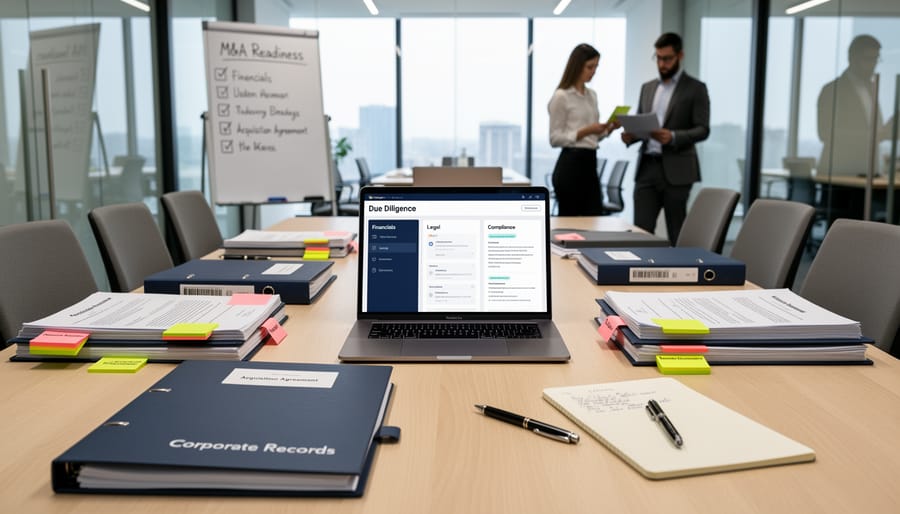
Certain issues can stop a deal cold or drastically reduce your valuation. Before you reach out to a single buyer, audit your business for these common red flags and address them methodically.
Co-founder disputes rank among the most damaging issues acquirers encounter. If you and your co-founder disagree about selling, exit terms, or future roles, resolve that tension privately first. Buyers want committed sellers, not conflicting signals across the cap table. Document clear agreements about decision-making authority and exit preferences before entering any conversations.
Unclear intellectual property ownership kills more Canadian startup deals than founders realize. Verify that all code, designs, trademarks, and proprietary processes are properly assigned to the company, not lingering in individual founder or contractor names. Review every freelancer and consultant agreement to confirm IP transfer clauses were executed. If you used open-source components, document compliance with their licenses.
Customer concentration presents another critical vulnerability. If more than 30 percent of your revenue comes from a single client, or if your top three customers represent the majority of sales, buyers will discount your valuation or demand earnout structures. Diversify your customer base or secure long-term contracts with key accounts to demonstrate stability.
Regulatory non-compliance can derail deals entirely, particularly for Canadian startups selling cross-border. Ensure your corporate filings are current in every province where you operate, your tax remittances are up to date, and you understand how your business fits into Canada’s merger review process if the acquisition exceeds certain thresholds.
Employment issues surface frequently during due diligence. Misclassified contractors, verbal-only offer letters, missing stock option paperwork, or outstanding termination grievances will all raise alarms. Clean up employment files, formalize agreements, and resolve any lingering disputes before you engage buyers.
Step-by-Step: How to Find and Approach Potential Buyers
Step 1: Map Your Ideal Buyer Profile
Start by asking yourself a single question: who gets more valuable by owning what you’ve built? The answer shapes everything about your buyer search.
Most Canadian founders default to obvious competitors, but that’s often the narrowest option. Your ideal buyer depends on what you’ve actually built. If you’ve captured market share in a crowded space, yes, competitors want to eliminate a threat and absorb your customers. If you’ve developed proprietary technology or a unique capability, platform companies see you as a faster route to expansion than building internally.
Private equity groups enter the picture when you operate in a fragmented industry they’re actively consolidating. They’re buying revenue streams and operational infrastructure, not innovation. Meanwhile, strategic acquirers, often U.S. or international companies, view Canadian startups as their foothold into the market, valuing your regulatory knowledge, local relationships, and established presence as much as your product.
Map this by listing what makes your startup defensible. Is it your customer base, your technology, your team’s expertise, your market position, or your regulatory approvals? Each strength attracts different buyers. A healthcare startup with Health Canada clearances appeals to foreign medtech companies entering Canada. A B2B SaaS tool with strong integration capabilities fits platform players expanding their ecosystem.
Don’t guess, research who’s acquired similar Canadian companies in the past three years. Their pattern reveals their strategy.
Step 2: Build Your Target List
Once you’ve defined your ideal buyer profile, the next step is building a focused list of 10-15 companies or firms that genuinely match those criteria. Start with industry databases like Crunchbase or PitchBook, filtering for companies that have made acquisitions in your sector or geography. These platforms reveal acquisition history, funding rounds, and growth trajectories that signal buying intent.
Trade publications and M&A newsletters specific to your industry often announce deals before they hit mainstream press. Subscribe to relevant Canadian tech and business outlets, and set Google Alerts for keywords like “acquires,” “acquisition,” or your specific vertical combined with “Canada.”
LinkedIn becomes a research powerhouse here. Follow executives at target companies, track their hiring patterns (rapid team expansion often precedes acquisitions), and note mutual connections who could facilitate warm introductions. Check which VCs invested in companies that were later acquired by your targets, those investors understand the buyer’s appetite.
Monitor recent M&A activity through sources like the Toronto Stock Exchange filings or BDC reports on Canadian deals. Companies that recently acquired once are statistically more likely to acquire again within 18-24 months.
Prioritize quality ruthlessly. A thoughtfully researched list of twelve strategic fits beats a scattered list of fifty generic prospects. Your time matters more than coverage.
Step 3: Decide Between Direct Outreach and Using Advisors
The choice between running your own sale process and hiring professional help hinges on three factors: deal complexity, your network strength, and available capital.
For straightforward acquisitions under $5 million where you already have buyer relationships, direct outreach often works well. You save advisory fees (typically 3-8% of transaction value), control the timeline, and maintain direct communication with potential acquirers. This path suits founders with M&A experience, strong industry connections, and bandwidth to manage negotiations while running the business.
Above $10 million, or when crossing borders into U.S. markets, bringing in a financial advisor changes the game. Advisors create competitive tension by approaching multiple buyers simultaneously, handle valuation justification, and navigate complex deal structures you might miss. They also preserve your relationship capital, if negotiations sour, the advisor takes the heat.
Boutique Canadian M&A firms understand local tax considerations, SR&ED credits, and cross-border structuring nuances that big banks often overlook. They work on smaller deals (down to $2-3 million) that don’t interest major investment banks, and their fees reflect startup realities through success-based structures rather than large retainers.
The hybrid approach works too: identify and vet buyers yourself, then bring in a financial partner to manage due diligence and closing once you’ve narrowed to serious prospects.
Step 4: Craft Your Initial Outreach
Your first contact with a potential buyer is a delicate balance: spark genuine interest without giving away your competitive secrets or appearing desperate. Most successful Canadian founders use a two-part approach, a brief introductory email followed by a one-page teaser document shared only after initial interest.
Your email should be personal and specific. Reference why this particular buyer makes strategic sense (“Your recent expansion into healthcare SaaS aligns perfectly with our customer base”), mention any mutual connection, and propose a conversation rather than pitching a sale. Keep it under 150 words. Never attach the teaser to this first email, wait for a response showing interest.
The teaser itself highlights your traction, market position, and strategic value without naming customers or revealing proprietary metrics. Think revenue range, not exact ARR. Customer segments, not client lists. Growth trajectory, not detailed P&L.
Timing matters. Tuesdays through Thursdays work best. Avoid month-end when finance teams are swamped. If you don’t hear back within a week, one polite follow-up is professional, two feels pushy. Throughout, use a personal email and NDA any detailed materials before sharing. Confidentiality protects your negotiating position and prevents information leaking to competitors.
Step 5: Cultivate Inbound Interest Simultaneously
While you’re executing direct outreach, build long-term visibility that brings buyers to you. Canadian founders often underestimate how strategic visibility accelerates acquisition conversations.
Start with conference presence at industry events where acquirers scout talent. Speaking slots carry more weight than booth attendance. Share real metrics and challenges, not polished pitches. U.S. conferences like SaaStr or TechCrunch Disrupt put you on radar screens that matter.
Publish thought leadership consistently. Write for industry publications about problems you’ve solved, contribute to open-source projects, or launch a strong social media strategy showcasing your team’s expertise. Guest appearances on entrepreneurial podcasts amplify reach beyond your immediate network.
Form industry partnerships strategically. Integration partnerships with larger platforms create natural acquisition pathways. Joint case studies and co-marketing initiatives build familiarity with potential buyers.
Network with intention. Cultivate relationships with corporate development teams at target companies long before you’re ready to sell. Share market insights, introduce them to customers, offer genuine value. Even tactical moves like coordinated holiday marketing campaigns with strategic partners build the trust that converts casual interest into serious acquisition discussions when timing aligns.
Alternative Pathways: Beyond Direct Outreach
Direct outreach isn’t the only way acquisition conversations start. Many Canadian founders connect with buyers through channels they’ve been quietly building for years.
Competitive bid processes, run by M&A advisors, flip the script entirely. Your advisor approaches multiple qualified buyers simultaneously, creating a structured timeline and competitive tension. This works particularly well when your startup has strong metrics and multiple potential acquirers. The process typically runs eight to twelve weeks, ending with competing offers and better terms than you’d likely negotiate alone.
Investor networks often catalyze deals without formal processes. Your existing VCs or angel investors maintain relationships with corporate development teams and private equity groups. When they see strategic fit, they make introductions. Board members do the same. These warm channels carry implicit validation, the introduction itself signals you’re worth exploring.
Accelerator and incubator alumni networks create unexpected pathways. Canadian programs like Creative Destruction Lab, Next Canada, and Communitech maintain relationships with acquirers scouting their cohorts. Years after graduating, founders receive inbound interest because an acquirer remembered them from demo day or tracked their progress through program updates.
Industry consolidation waves sweep up companies regardless of whether they’re actively selling. When a sector hits critical mass, like Canadian fintech in 2024 or healthtech in 2025, acquirers move quickly to gain market share. Founders who’ve built visibility suddenly field multiple inquiries within weeks.
Partnership programs offer lower-risk entry points. Some acquirers run pilot integrations or reseller arrangements that function as extended courtship. You prove compatibility through working together before acquisition terms ever surface. This pathway takes longer but dramatically reduces deal risk for both sides.
How to Know You’ve Found the Right Buyer

Finding the right buyer isn’t just about who offers the highest price, it’s about identifying a partner who will honor your vision, treat your team fairly, and actually close the deal. After months of conversations, you need clear signals that separate serious acquirers from tire-kickers.
Cultural alignment reveals itself in how the buyer talks about your team and customers. Do they ask thoughtful questions about your company values and employee retention plans? Are they curious about why customers choose you, or do they only focus on cost synergies? A compatible buyer views your people as assets to retain, not headcount to eliminate. Pay attention to how they describe integration: vague promises about “keeping things the same” often mask future disruption, while specific plans for preserving key relationships show genuine respect for what you’ve built.
Valuation alignment goes beyond the headline number. A serious buyer presents an offer grounded in comparable transactions and your actual metrics, not a lowball bid hoping you’re desperate. They explain their valuation methodology and listen when you present counter-evidence. Earnest money or a signed letter of intent (LOI) with a meaningful deposit demonstrates commitment, it’s easy to talk about buying a company, harder to put money at risk.
Look for these concrete verification signals throughout the process:
- Buyer provides proof of funds or confirmed financing within two weeks of LOI signing
- Due diligence requests are organized and reasonable, not fishing expeditions with hundreds of random demands
- Your advisors or investors recognize the buyer’s name and confirm their reputation for closing deals
- The buyer meets your team respectfully and asks about their career goals post-acquisition
- They present a detailed 90-day integration roadmap, not vague assurances
- Legal counsel moves promptly and collaboratively rather than creating artificial delays
Red flags include constantly shifting terms, excessive delays without explanation, or unwillingness to let you speak with founders from their previous acquisitions. A buyer who resists reference checks or becomes defensive about their track record isn’t worth your time. Trust your instincts, if something feels off during courtship, it rarely improves after signing.
Common Questions Canadian Founders Ask About Selling
How long does a typical sale take from first conversation to close?
Most Canadian startup acquisitions take three to six months once serious discussions begin, though complex deals or cross-border transactions can stretch to nine months or longer. The timeline depends heavily on deal size, buyer type, due diligence depth, and regulatory considerations.
Should I talk to multiple buyers at once?
Yes, running a competitive process usually yields better terms and valuation. However, maintain strict confidentiality, stagger conversations thoughtfully to avoid burning relationships, and be transparent with each party that you’re exploring options rather than exclusive.
Do I need a lawyer before starting conversations with potential buyers?
You don’t need one for initial exploratory talks, but engage legal counsel before sharing detailed financials, signing an NDA with binding provisions, or receiving a letter of intent. A lawyer experienced in M&A can spot deal-killing terms early and structure protections you’ll need.
What if my co-founder doesn’t want to sell?
This is a major obstacle that can derail or kill a deal. Address the disagreement privately first, explore whether earnouts or different rollover equity structures could bridge the gap, and review your shareholder agreement for dispute resolution mechanisms. If alignment proves impossible, one founder buying out the other may be necessary before pursuing acquisition.
How do cross-border deals with U.S. buyers affect the process and taxes?
U.S. buyers bring larger markets and often higher valuations, but expect more rigorous due diligence and longer timelines for regulatory clearance. Tax implications can be significant, Canadian founders face different capital gains treatment, potential withholding taxes, and currency considerations, so consult a cross-border tax specialist early to structure the deal tax-efficiently.
Can I keep working at the company after the acquisition?
Many acquirers require founders to stay on for an earnout period, typically 12 to 36 months, to ensure knowledge transfer and business continuity. Negotiate these terms carefully, clarify your role, reporting structure, decision-making authority, and what happens if the relationship sours.
These questions surface repeatedly because selling a startup involves navigating unfamiliar territory under pressure. The founders who handle exits most smoothly are those who seek answers early, build a small advisory team they trust, and recognize that nearly every concern has a precedent and a solution. Don’t let uncertainty paralyze you, most of these challenges have standard remedies once you understand the landscape.

Selling your startup isn’t the finish line, it’s a strategic milestone you can shape on your own terms. The founders who secure the best outcomes rarely wake up one day and decide to sell. They build acquisition-ready practices into their operations from the start, treating clean financials, clear IP ownership, and strong customer relationships as non-negotiables regardless of exit plans.
Start preparing now, even if a sale is years away. That preparation doesn’t just make you attractive to buyers; it makes you a better operator. Companies built with transparency, documented processes, and scalable systems naturally command higher valuations when the time comes.
Remember that the most successful acquisitions often begin as something else entirely. A partnership discussion, a customer relationship, a casual conversation at a conference, these interactions plant seeds that can grow into acquisition conversations when timing and strategy align. Approach potential buyers as collaborators first, not just transaction targets.
You control more of this process than you might think. While market conditions and buyer appetite matter, your preparation, your network, and your clarity about what you want determine how and when you exit. Whether you sell next year or build for a decade before entertaining offers, that choice belongs to you.
The Canadian startup ecosystem needs more founders who exit successfully and reinvest their experience and capital into the next generation. Your acquisition isn’t just your win, it’s fuel for what comes next.